Twinleaf Sensor Interconnect
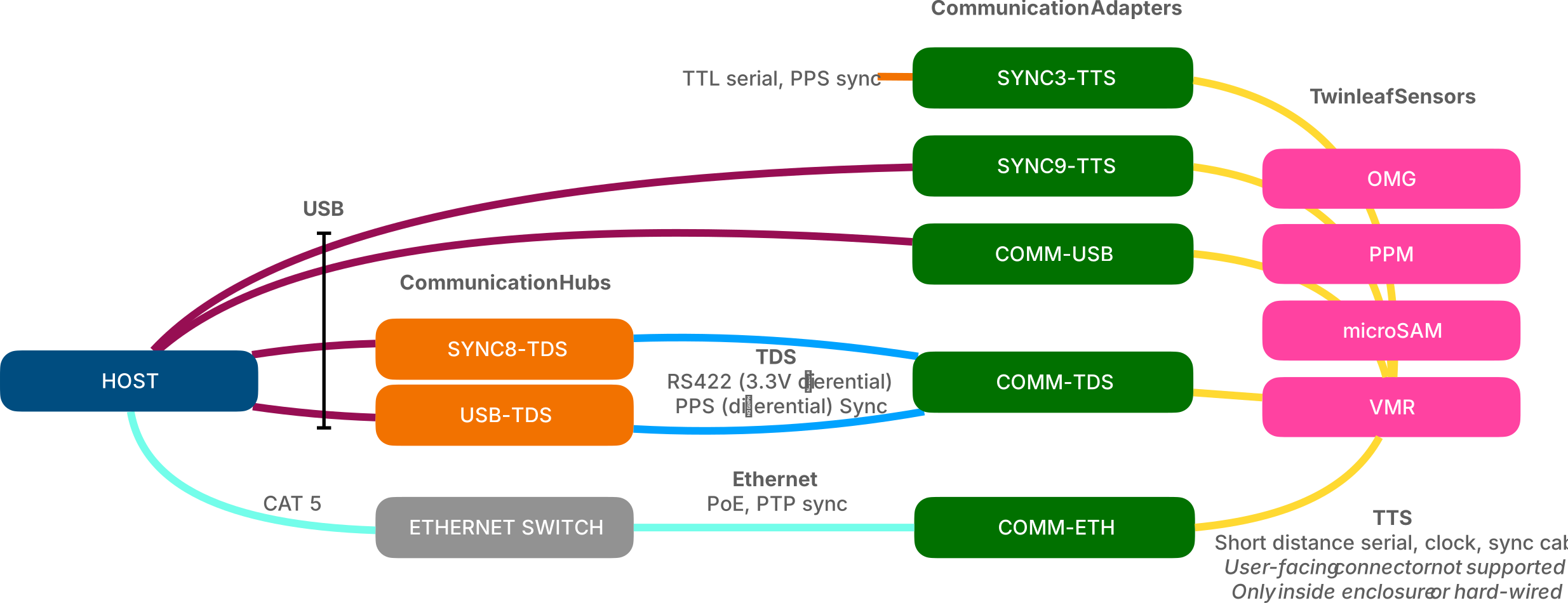
There are several communication adapters and data transports used with Twinleaf sensor data:
-
RS422
- Twinleaf Differential Serial (RS422).
- Supports long lengths up to 1 km.
- Cable: Four twisted pair wire, like CAT5/6.
- Power: 15-50 V
- HUB-8RS422 supports 8 channels RS422 cables
-
Ethernet
- Protocol: UDP (RFC 768).
- Power: Power over ethernet (IEEE 802.3af).
- Synchronization: Precision Time Protocol (IEEE 1588-2008) (Planned for 2026)
- Cable: Only two twisted pairs required.
-
USB Serial
- USB-C ports and cables.
- USB CDC Profile (virtual serial port).
- Synchronization: PPS input optional.
- Communication adapter name: COMM-USB.
-
SD Card and GPS
- USB-C ports and cables.
- HUB-8TTS supports 8 channels serial/TTS links
- GPS or external PPS synchronization
- Supports 3 cannels serial/TTS links
- External PPS synchronization
-
TTL Serial
- Twinleaf TTL serial module (COMM-TTL).
- Ideal for interfacing with embedded systems; one sensor per module.
-
Native Serial
- Twinleaf TTL Serial (TTS).
- The native sensor link used for very short internal connections to communication adapters and certain synchronization units.
Each of the first three protocols is implemented by a communication module that can be specified and installed inside the sensor. The RS422 sensor link is commonly used for sensors designed to operate in the field. The USB adapter is commonly used for devices designed for office or laboratory use. A different communication adapter can be specified at the time of order. The TTS link is the "native" link used by sensors and does not employ any additional module. TTS is only offered to system integrators who are specifically trained in its use. This diversity of options reflects the variety of applications for our sensors. Before placing an order, we strongly recommend sending us an email describing your application to obtain a suggested configuration.
All of the communication modules measure acceleration, rotation, barometric pressure, and temperature.
Routing
Most Twinleaf devices contain one or more communication modules in front of the sensor. Each module adds one level to the route.
With one communication module, the module is at / and the sensor is at /0. Select the sensor in the command-line tools with -s/0.
An RS422 system commonly passes through a host-side RS422 hub and then an RS422 communication module inside the device:
- routing
/: RS422 hub - routing
/0: RS422 communication module - routing
/0/0: sensor
Select the sensor in this arrangement with -s/0/0, for example:
tio rpc list -s/0/0
Data from each module remains available at its own route. The tio list device tree and the device manual can help identify the correct sensor route. tio monitor and tio log require no route: monitoring displays the full tree, and logging records it all.
Note that the pre-2025 legacy SSD connection is closely related to the RS422 standard. For short (few meter) cable lengths, devices having SSD ports can connect to RS422 host ports without synchronization. The RS422 links support very long cable lengths.